Energy Storage in Vermont.

Green Mountain Power runs the most generous residential battery program in the country. Two Powerwall 3 units (27 kWh) for $55/month or $5,500 upfront, and the BYOD grid-services payments typically cover the lease for life. VEC Flexible Load is the co-op equivalent. Vermont is the one state where a battery genuinely pays for itself.

Get my report See the rate-hedge math
$55/mo
GMP Powerwall lease (2 units)
up to $10,500
BYOD lifetime payment cap
27 kWh
Combined usable capacity
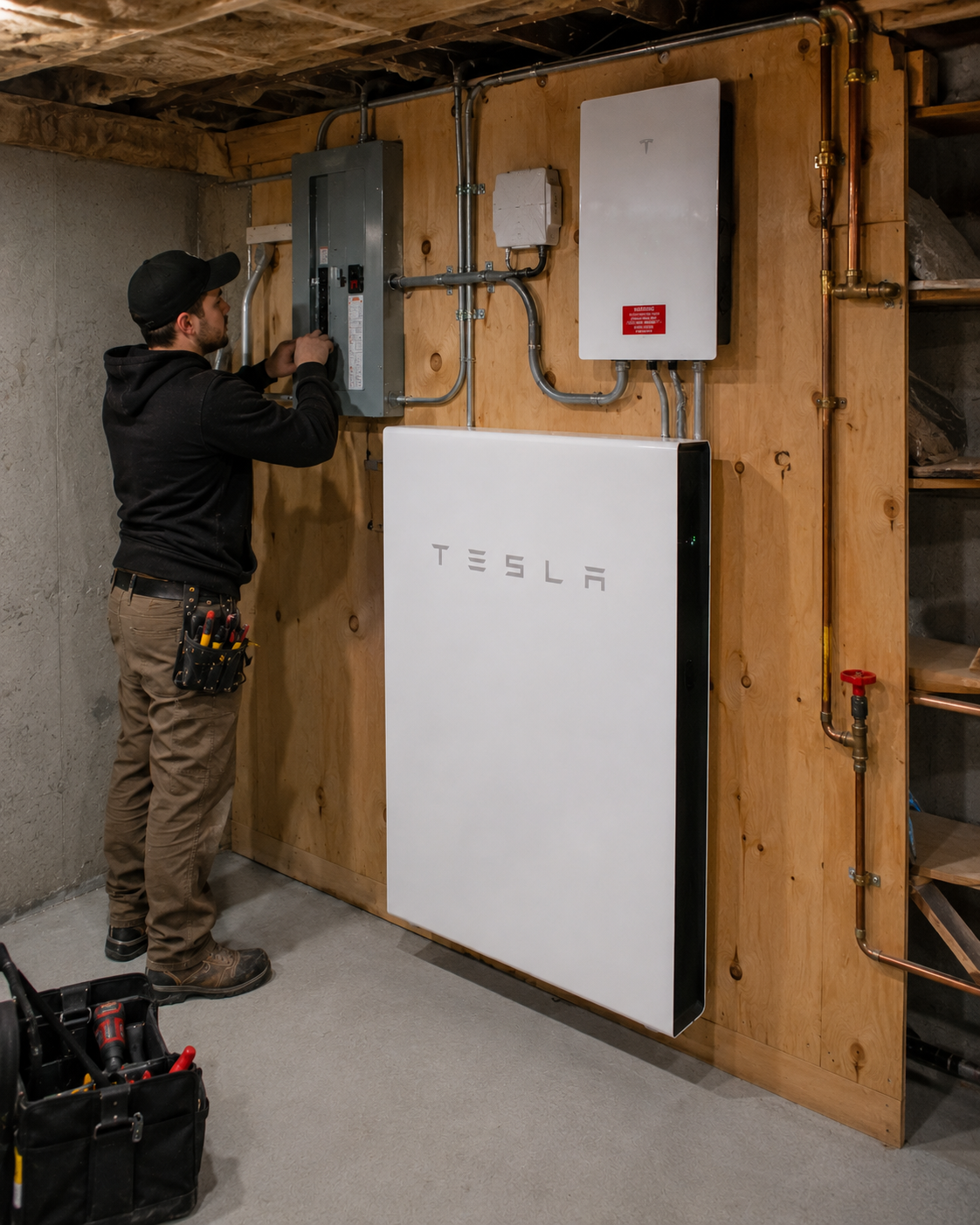
A Green Mountain Power Powerwall installation, a wall-mounted Tesla battery enrolled in the GMP Bring Your Own Device program at a Vermont home
Why now · Vermont

VT rates climb slower than the rest of New England.

Vermont residential electricity climbed from roughly 15.9¢/kWh in 2010 to ~22.6¢/kWh today, averaging only about 2.2% per year, the slowest climb in New England thanks to regulated GMP supply and a hydro-rich mix. The case for storage here isn't rate volatility, it's GMP's Powerwall lease + BYOD program, which pays you to enroll a battery.

The hedge GMP lease + BYOD lifetime payments
Get my report
Vermont residential electric rate
2010–2025 · cents per kWh, all-in
$0 low mid high 2010 2015 2020 2025 US avg $0.169/kWh VT all-in $0.226/kWh $0.159/kWh Your stored kWh (BYOD dispatch) value of every shifted kWh ¢/kWh, residential all-in
VT residential rate Your stored kWh US national average
Source · EIA Form 861, residential class, 2010–2025. State averages and the US national line both pulled from the same dataset for an apples-to-apples comparison.
Major utilities coveredGreen Mountain Power (GMP), VEC, Burlington Electric, Stowe Electric, Washington Electric Co-op
A real example · Vermont

What two Powerwall 3 units earn under GMP.

Take a GMP customer in Burlington who leases two Powerwall 3 units (27 kWh total) for $55/month. GMP dispatches the batteries during summer grid peaks under the BYOD tariff and pays the homeowner per kW of capacity provided. A solar-retrofit bonus and a geo-targeted bonus stack on top. The 10-year math is the rare residential battery program that's actually net-positive.

See the pieces of the stack
01 · Why It Works Here

What makes a battery pay back in Vermont.

GMP covers about 75% of Vermont's electric territory. Its Powerwall lease + BYOD program is genuinely unique: GMP absorbs the install premium and the grid-services payments tend to cover the lease for life. VEC Flexible Load is the co-op equivalent for the northern half of VT.

$55/mo
GMP lease, 2 Powerwall 3
10-year term, $5,500 upfront alternative, 27 kWh total usable capacity
$850-950/kW
BYOD capacity payment
3-hr dispatch $850/kW, 4-hr dispatch $950/kW, plus $100/kW solar/geo bonuses
27 kWh
Combined usable capacity
Two Powerwall 3 units, runs a heat pump + essentials for 24-36 hrs in subzero weather
10 yrs
Program term & warranty
GMP handles all maintenance and service for the term; backup power included free
Get my report
02 · The Components

Every value line, spelled out.

A Vermont home battery earns three ways at once: a subsidized GMP lease (or matching VEC deal), grid-services capacity payments, and stackable solar and geo bonuses. Each line stands on its own. Stacked, they're the math that makes VT the most generous residential battery state in the country.

  • GMP Powerwall 3 lease (10 years, 2 units, 27 kWh total)$55/mo or $5,500 upfront
  • BYOD capacity payment, 3-hour summer dispatch$850/kW
  • BYOD capacity payment, 4-hour summer dispatch$950/kW
  • Solar retrofit bonus ($100/kW), if paired with existing arraystacks
  • Geo-targeted bonus ($100/kW), grid-constrained circuitsstacks
  • VEC Flexible Load (co-op equivalent, 5 kW battery)$32/mo or $1,340 upfront
  • Backup power during outages, no fuel, GMP-maintainedincluded free
Get my report
03 · Install Timeline

From first call to first BYOD payment.

A typical Vermont GMP Powerwall install runs 5–8 weeks from application to commissioning, faster than most states because GMP runs the program directly and handles much of the paperwork.

01.
GMP Powerwall application + lease decision
Online application to GMP. Choose lease ($55/mo) or upfront ($5,500). Pre-approval within ~10 business days. VEC customers apply through the Flexible Load program instead.
Week 1
02.
Site survey & load study
GMP-approved installer does an in-home electrical assessment, panel inspection, NEC 705.12 calculation. Designs the critical-loads backup panel and confirms solar-retrofit bonus eligibility.
Weeks 2-3
03.
Permits + GMP interconnection
Town building/electrical permit and GMP interconnection paperwork in parallel. GMP handles most of the utility-side coordination for you.
Weeks 3-5
04.
Installation & BYOD commissioning
Install is typically 1 day on-site for two Powerwall 3 units. Commissioning enrolls the battery in the BYOD dispatch API immediately. Backup test confirms real runtime on your specific loads.
Weeks 5-7
05.
First BYOD payment + standing by
GMP delivers the first capacity payment as an electric-bill credit at the end of Q1 the year following enrollment. Meanwhile the battery dispatches on grid peaks and stands by for any outage.
Post-install
Get my report
04 · Honest FAQ

The real questions Vermont homeowners ask.

Actual questions that come up in the first installer conversation, answered for a typical Vermont homeowner in 2026.

Does GMP really pay me to install a battery?

Yes. The BYOD program pays $850–$950/kW per year of dispatch capacity, plus optional $100/kW bonuses for solar-paired batteries and geo-constrained circuits. A 5 kW Powerwall 3 typically clears $850–$1,050/year. Over 10 years, that's $8,500–$10,500, which usually exceeds the $55/mo lease cost of $6,600. Net result: the battery pays for itself and then some, with backup power included free.

What if I'd rather buy the Powerwall outright?

A purchase option is available at $5,500 upfront for the same two Powerwall 3 lease (a meaningful discount off retail). After year 10, ownership transfers to you and the battery keeps dispatching on BYOD with no lease payment offsetting the bill credit. The upfront option pencils better for long-stay homeowners; the monthly lease is cleaner if you might move within the 10-year window.

I'm with VEC or Burlington Electric, not GMP. What's available?

VEC (Vermont Electric Co-op) runs Flexible Load, which pays $32/month (or $1,340 upfront) for a 5 kW battery in dispatch service, plus $16/month for some smaller setups. The economics aren't as generous as GMP but the structure is similar: subsidized lease, ongoing dispatch credits. Burlington Electric and the smaller munis don't run a comparable program, so a direct-purchase battery + outage value is the only path there.

Does BYOD dispatch leave me without backup during outages?

No. The battery prioritizes your home's backup loads any time the grid goes down. BYOD only dispatches during scheduled grid peak events while the grid is healthy. If a storm hits during a dispatch window, the program switches modes automatically.

Can I add the battery to existing solar?

Yes, and you should. The $100/kW solar-retrofit bonus stacks on top of the standard BYOD rate, and a solar-paired battery dispatches more aggressively (and earns more) because the panels keep it topped up. Net metering credits stay intact, the battery just lets you self-consume more midday production before exporting.

How long do two Powerwalls run my house through an outage?

27 kWh of usable capacity. For an essentials-only backup panel (heat pump or boiler, well pump, fridge, freezer, internet, lights), that's typically 24-36 hours of subzero winter weather, longer in milder seasons. Paired with solar, the panels can keep the battery topped up across multi-day outages so long as there's daylight.

Explore more

Other states and programs.

Looking for the same kind of program in another state, or a different program in yours? Tap any pill to jump.

See how storage fits your specific Vermont home.

Your Home Efficiency Score confirms GMP vs. VEC vs. muni territory, sizes the right Powerwall configuration for your panel and bill, models the 10-year BYOD math, and shows real backup runtime based on your address.

Get my report