Energy Storage in Maine.

Longest rural distribution lines in New England. Highest oil-heat dependency in the country. Winter storms that routinely take rural homes offline for 24-48 hours. A battery up here isn't a backup gadget, it's a working-house tool that keeps the heat on.

Get my report See the rate-hedge math
~$0.30/kWh
Avg residential electric rate
12-48 hrs
Typical rural winter outage
~58%
ME homes that heat with oil
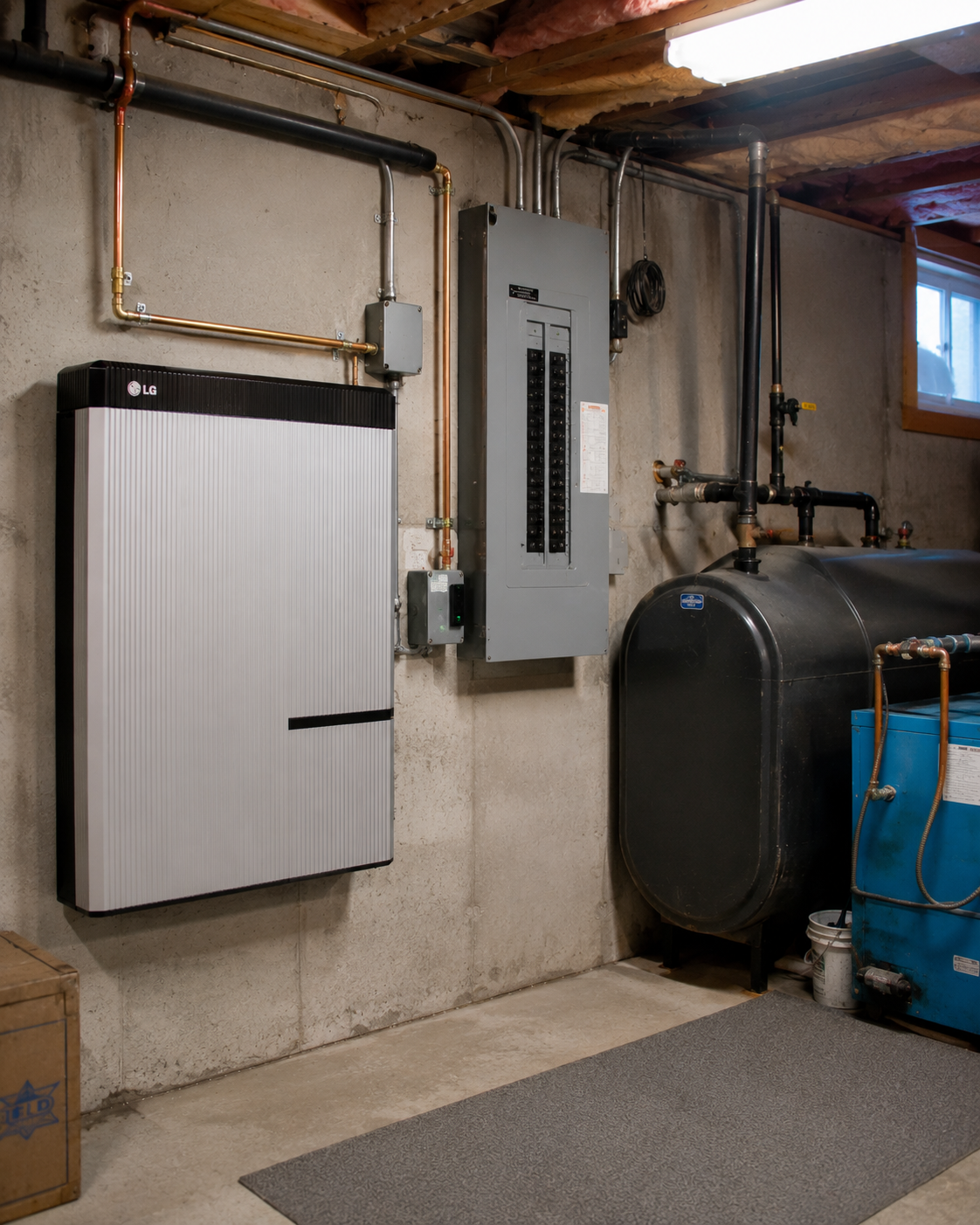
A wall-mounted residential battery storage system installed in a Maine home, clean utility install with conduit visible
Why now · Maine

Electric bills have climbed every year.

Maine residential electricity climbed from roughly 15.7¢/kWh in 2010 to ~27¢/kWh today, averaging close to 4% per year. CMP and Versant supply rates jumped about 20% effective January 2026. Maine doesn't have a dedicated battery dispatch program, so the value lives in resilience (rural lines, hard winters) and solar self-consumption (NEB credits at full retail).

The hedge Storm resilience + NEB self-consumption
Get my report
Maine residential electric rate
2010–2025 · cents per kWh, all-in
$0 low mid high 2010 2015 2020 2025 US avg $0.169/kWh ME all-in $0.27/kWh $0.157/kWh Your stored kWh (self-consumption) value of every shifted kWh ¢/kWh, residential all-in
ME residential rate Your stored kWh US national average
Source · EIA Form 861, residential class, 2010–2025. State averages and the US national line both pulled from the same dataset for an apples-to-apples comparison.
Major utilities coveredCentral Maine Power (CMP), Versant Power
A real example · Maine

What a 13.5 kWh Powerwall does in a Maine home.

Maine has no utility dispatch program for residential batteries, so the value lives in two places: keeping the heat (and your fridge) on for 24-48 hours through every rural winter outage, and storing midday solar production to self-consume in the evening at full retail rates.

See the pieces of the stack
01 · Why It Works Here

Maine batteries earn their keep differently.

In dense suburban grids, batteries are mostly about peak shaving and dispatch programs. In rural Maine, the math is simpler: keep the heat running through a Nor'easter, keep the well pump going, keep the freezer cold. The economics that follow are built on top of the resilience case.

Rural lines mean longer outages.

Maine is a state of long, sparse distribution lines running through dense forest. Versant Power serves the most rural territory in the Northeast, northern and eastern Maine, where per-customer infrastructure costs are highest and storm restoration takes the longest. CMP territory in southern Maine fares better but still sees regular multi-day events along the coast and in the western foothills.

Falling trees, ice loading, and wind-loaded wet snow take down rural feeders in ways no amount of grid hardening fully prevents. A typical winter storm year leaves rural ME homes offline for 12-48 hours at a stretch, sometimes longer.

Oil heat needs electricity to run.

Maine has the highest oil-heat share in the country, roughly 58% of homes. People often assume an oil-heated house "doesn't need electricity" during an outage. They're wrong: the burner ignition, the circulator pumps, and the thermostat all run on grid power. Lose the grid, lose the heat, even with a full oil tank.

A modest battery, even 5-10 kWh, can keep a typical Maine boiler running for several days during an outage. Pair it with a properly sized array and the battery recharges from solar each morning, giving you indefinite winter resilience without ever burning a drop of generator fuel.

~58%
ME homes that heat with oil
Highest oil-heat share in the country, the burner needs grid power to run
12-48 hrs
Typical rural winter outage
Long sparse lines through forest, Versant and CMP storm restoration windows
13.5 kWh
Powerwall 3 usable capacity
Runs a typical oil boiler, well pump, fridge, and a circuit of lights for days
10 yrs
Manufacturer warranty
70% capacity retention at year 10, unlimited cycles, NEB-compatible
Get my report
02 · The Components

Every value line, spelled out.

Maine doesn't run a utility dispatch program for residential batteries, so the value flows through resilience and solar self-consumption. Each line stands on its own. Stacked, they're the math that makes the project pencil up here.

  • Solar self-consumption boost (~2,500 kWh shifted at ~$0.27/kWh)~$675/yr
  • Resilience value (avoided generator fuel, spoilage, hotel nights)$500-1,500/yr
  • Net Energy Billing (NEB) full-retail credit, battery preserves itstacks with solar
  • Combined annual value, oil-heated rural ME home with solar$1,200-$2,200/yr
  • Lease/PPA financing available, ITC passed through in paymentsno money down
  • Backup runtime (typical 13.5 kWh, oil boiler + essentials only)2-4 days
  • Equipment lifespan and warranty10 yrs · 70% capacity
Get my report
03 · Install Timeline

From first call to battery on the wall.

A typical Maine battery install runs 7–12 weeks from first call to Permission to Operate, with full backup runtime tested at commissioning.

01.
Site survey & load study
In-home electrical assessment, panel inspection, NEC 705.12 calculation, oil-boiler/heat-pump load profile. Designs the critical-loads backup panel for storms.
Weeks 1-2
02.
Permits + CMP/Versant interconnection
Town building/electrical permit, utility interconnection application, NEB paperwork in parallel if pairing with solar. Most ME jurisdictions issue battery permits within 4 weeks.
Weeks 3-6
03.
Equipment procurement
Powerwall 3 (or Enphase IQ Battery, FranklinWH) ordered. Lead time 2-6 weeks depending on installer supply allocation. Often overlaps with permit work.
Weeks 4-8
04.
Installation & commissioning
Install is typically 1-2 days on-site. Backup test at commissioning confirms real runtime on your specific boiler and essentials. Utility witness/PTO follows in 1-2 weeks.
Weeks 7-10
05.
Battery live, standing by
Battery charges from solar (or off-peak grid), self-consumes in the evening, and seamlessly takes over the loads panel the next time the lights flicker. App notifies you of outages while you're away.
Post-install
Get my report
04 · Honest FAQ

The real questions Maine homeowners ask.

The questions that actually come up in the first installer conversation, answered straight, for a typical ME homeowner in 2026.

What loads should a rural Maine battery actually back up?

Almost everyone in rural ME prioritizes the same essentials: the boiler or heat pump, the well pump, the fridge, the chest freezer, internet, and a couple of light circuits. That bundle averages 5-15 kWh per day depending on the house, which is well within reach of a single 13.5 kWh battery. AC, electric ranges, and EV charging are the loads typically left off the backup panel unless you're sizing for two batteries.

How long do winter outages actually last up here?

Highly variable by location. Coastal southern ME homes often see 2-12 hour outages in a typical winter. Rural CMP territory in the western foothills sees 12-36 hours regularly during ice storms. Versant territory in the north and Down East routinely runs 24-48 hours after a major event, and longer during widespread storms when crews work outward from population centers. Sizing the battery against your worst-case historic outage, not the average, is the right approach.

If I get a heat pump, do I need more battery?

A bit, depending. Cold-climate heat pumps draw most of their power on the coldest nights, exactly when storms tend to hit. If you're keeping oil as a backup, the battery only needs to run the boiler in a power outage. If you've gone heat-pump-primary, sizing typically jumps to two batteries to cover heating load through a 24-hour outage. The Score models both scenarios with your specific equipment.

Does a battery interfere with my Net Energy Billing credits?

No. NEB credits your exported solar at retail rate. A battery just routes some of your midday production to home use rather than the grid, which doesn't reduce credit value, it just shifts when your home draws against the grid. If anything, a battery makes a smaller solar array stretch further, since you're self-consuming more efficiently.

Battery vs. propane generator, which is the better Maine choice?

Both have a place. A propane generator runs as long as the tank lasts and handles whole-house load through any outage length, but requires fuel deliveries, annual service, and emits noise and exhaust. A battery is silent, requires no fuel, recharges from solar, and qualifies for ~30% pass-through if financed via lease/PPA, but caps your runtime at the size of the battery. Most rural Maine homeowners keeping a generator add a battery alongside it; the battery covers 95% of outages without ever starting the generator, and the generator is reserved for the rare multi-day events.

Can a battery help me go off-grid?

True off-grid in Maine, disconnected from the utility entirely, generally requires significantly more battery than a grid-tied resilience setup, plus a backup generator, plus careful load management. It's possible, but for most ME homeowners the goal is grid-tied with battery backup: you keep the utility connection (and NEB credits), and the battery covers any outage. The Score lays out the trade-offs if you're considering the full off-grid path.

Explore more

Other states and programs.

Looking for the same kind of program in another state, or a different program in yours? Tap any pill to jump.

See how storage fits your specific Maine home.

Your Home Efficiency Score sizes the right battery for your panel, your bill, and your outage profile, runs the rate-hedge math, and shows your real backup runtime, based on your address and your actual utility.

Get my report