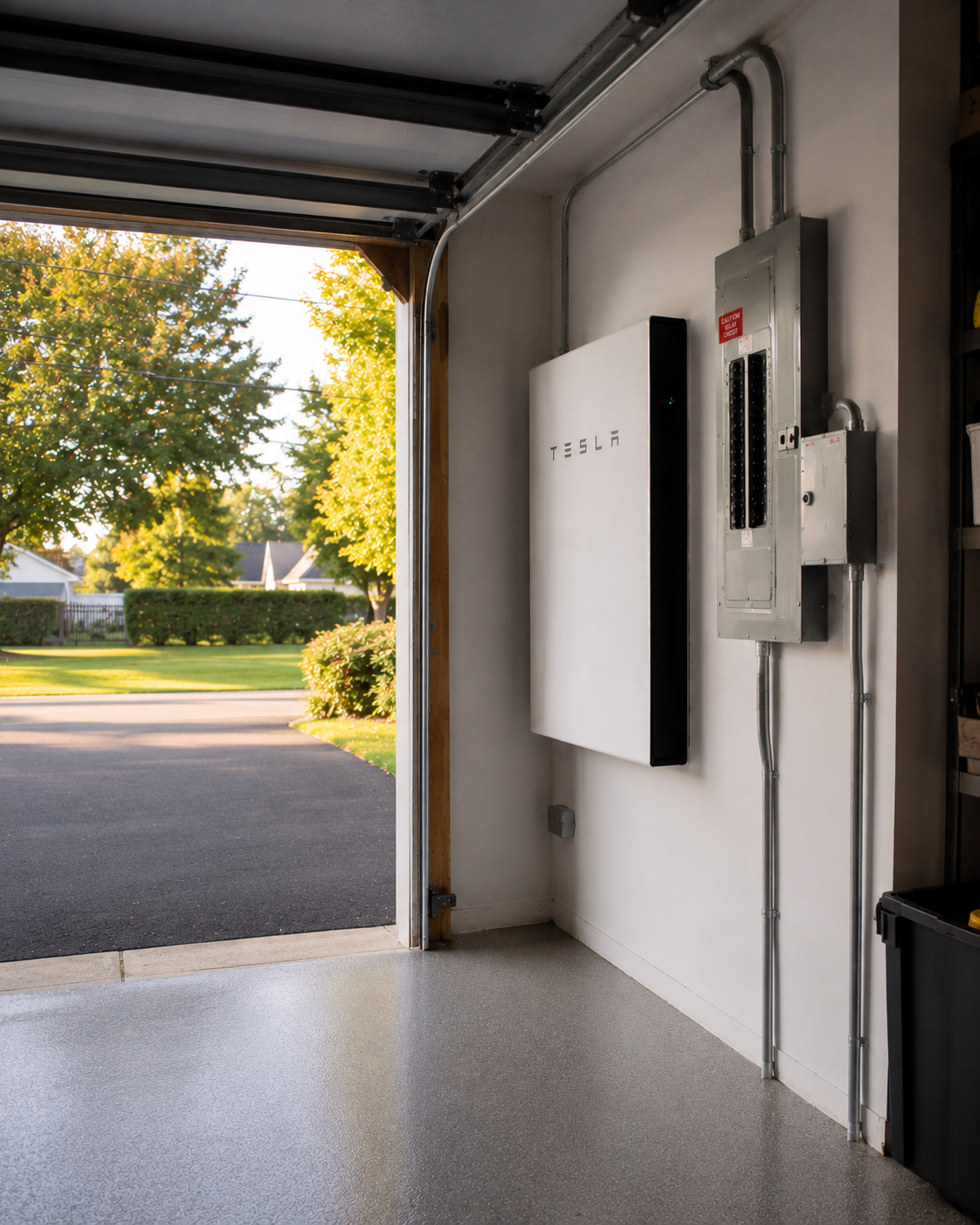
NYSERDA pays $200-$250/kWh up front, capped near $6,250 on Long Island. ConEd customers add 2-6 PM ToU arbitrage. Bring Your Own Battery enrollment adds ongoing summer payments. And every coast home from Westchester to the Rockaways still remembers Sandy. New York is the only state where a battery pencils on cash flow, bills, and backup all at once.

New York residential electricity climbed from roughly 18.7¢/kWh in 2010 to ~26.5¢/kWh statewide today, with ConEd customers paying closer to 30¢/kWh. The Public Service Commission approved an average 5.7% bill increase for ConEd in 2026. Every kWh you shift through a battery is worth more next year than it was last year, and NYSERDA pays for the kWh of storage up front.
Take a ConEd customer in Westchester who adds a Powerwall 3 to an existing solar array. NYSERDA pays $250/kWh of usable capacity up front through the Residential Energy Storage Incentive (capped roughly $6,000 per home in ConEd territory). The battery enrolls in ConEd's Bring Your Own Battery program for ongoing summer payments. And ConEd's voluntary Time-of-Use tariff lets it arbitrage the 2-6 PM super-peak every weekday.
See the pieces of the stackMost states give a battery one job: backup. New York gives it three: an upfront NYSERDA capacity rebate, an ongoing BYOB summer payment, and (for ConEd customers) a real arbitrage spread. The case looks different in Manhattan than in Buffalo, and the Score sizes both.
A New York home battery earns three ways at once: a NYSERDA capacity rebate paid the day the battery is enrolled, an ongoing BYOB summer credit, and (for ConEd customers) weekday ToU arbitrage. Each line stands on its own. Stacked, they're the math that makes NY the most multi-revenue battery state in the country.
A typical New York battery install runs 8–12 weeks from first call to Permission to Operate. NYSERDA processes the residential storage rebate after PTO is granted by your utility.
Actual questions that come up in the first installer conversation, answered for a typical NY homeowner in 2026.
No, and it's worth being honest about that. ConEd customers paying ~$0.30/kWh with a wide 2-6 PM ToU spread can build real arbitrage value into a battery's payback. Upstate National Grid customers paying $0.18-0.22/kWh on a flatter rate structure get less arbitrage, for them the case is mostly NYSERDA upfront cash plus resilience and solar self-consumption. Your Score reads your utility and tariff and weighs both.
ConEd's voluntary residential ToU tariff defines a super-peak window of 2-6 PM weekdays in summer, off-peak from 10 PM-8 AM weekdays plus all weekend, and shoulder periods in between. A battery charges from cheap off-peak grid (or your solar) and discharges through the super-peak hours, replacing the most expensive kWh of the day. Smart inverters from Tesla and Enphase automate the schedule.
Bring Your Own Battery is a demand-response program your utility runs (ConEd, PSEG-LI, Orange & Rockland, etc.). You agree to let the utility dispatch your battery during summer grid peak hours (typically 20-40 hours per year, capped). Your home backup gets priority any time the grid goes down. As of April 1, 2026, BYOB enrollment is required to receive the NYSERDA upfront incentive, a one-time form your installer handles for you.
Sandy left over 2 million NY customers without power, with full restoration in some Long Island and coastal Queens areas taking 10-14 days. The lesson most homeowners took away: portable generators ran out of fuel within 48 hours because gas stations were also without power. A solar+battery system that keeps recharging from the sun every day doesn't have that problem.
Almost always cheaper to add at install. The electrician is already there, the inverter is being sized, and certain hybrid inverters (Enphase, Tesla, SolarEdge) install much more cleanly when battery and panels are designed together. A paired install also makes the NYSERDA solar incentives and storage incentives both available on a single project, and stretches your solar credit-bank further into the winter.
Honest answer: no, not by itself. Cold-climate heat pumps draw 3-7 kW under heavy load, which a 13.5 kWh battery would deplete in a few hours. The right pattern for a NYS Clean Heat home is two batteries (or selectively backing up only essential circuits, fridge, well pump, lights, internet, gas-furnace blower if you still have one) and letting the heat pump cycle off during the outage. Your Score sizes for your actual heating load.
Looking for the same kind of program in another state, or a different program in yours? Tap any pill to jump.
Your Home Efficiency Score sizes the right battery for your panel and bill, models the NYSERDA rebate on your address, runs the ConEd ToU arbitrage math (or PSEG-LI BSR cap), and shows real backup runtime based on your utility.
Get my report