Energy Storage in New Hampshire.

Eversource pays a verified $230/kWh up front, capped at $3,000, to enroll your home battery in NHCEF's summer demand-response program. Layer that on top of NH's sub-retail net-metering, ice-storm resilience, and cold-climate heat pump load, the case for storage up here is the strongest in New England outside Mass Save.

Get my report See the rate-hedge math
$230/kWh
NHCEF upfront rebate
$3,000
Per-battery cap
14 days
Worst-case ice-storm outage
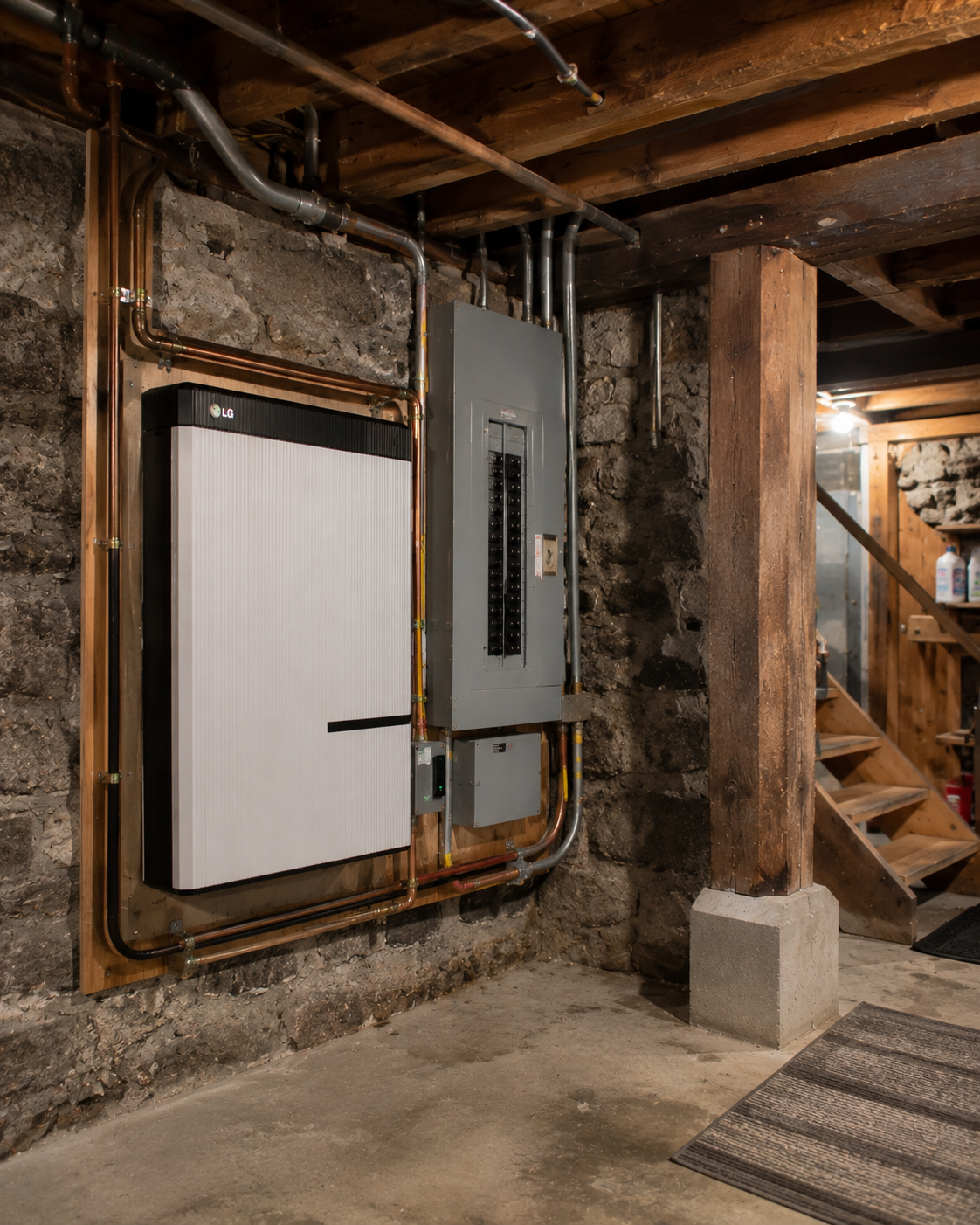
A wall-mounted residential battery storage system installed in a New Hampshire home, clean utility install with conduit visible
Why now · New Hampshire

Electric bills have climbed every year.

NH residential electricity climbed from roughly 16.4¢/kWh in 2010 to ~26.5¢/kWh today, averaging about 3.2% per year. Eversource supply rates jumped in early 2026 and the NHCEF battery rebate sits on top. With NH net-metering exporting at sub-retail rates, every kWh you self-consume from storage is worth more than every kWh you export from solar alone.

The hedge $3K upfront + sub-retail self-consumption
Get my report
New Hampshire residential electric rate
2010–2025 · cents per kWh, all-in
$0 low mid high 2010 2015 2020 2025 US avg $0.169/kWh NH all-in $0.265/kWh $0.164/kWh Your stored kWh (self-consumption) value of every shifted kWh ¢/kWh, residential all-in
NH residential rate Your stored kWh US national average
Source · EIA Form 861, residential class, 2010–2025. State averages and the US national line both pulled from the same dataset for an apples-to-apples comparison.
Major utilities coveredEversource, Liberty Utilities, Unitil, NH Electric Co-op
A real example · New Hampshire

What a 13.5 kWh Powerwall earns on the NH stack.

Take an Eversource home in southern NH that adds a Powerwall 3 alongside an existing solar array. NHCEF pays $230/kWh up to $3,000 the day the battery is enrolled. NH's sub-retail net-metering makes the kWh you self-consume in the evening worth ~$0.27 instead of the ~$0.13 you'd get exporting it. Ice-storm resilience is the third leg.

See the pieces of the stack
01 · Why It Works Here

New Hampshire batteries earn through resilience first.

NH's grid has a long memory of catastrophic ice events. Combine that history with the cold-weather load profile of a state that increasingly heats with electricity, and a residential battery becomes one of the highest-utility upgrades a Granite-State homeowner can make.

The 2008 ice storm still defines the conversation.

The December 2008 ice storm hit 211 of NH's 256 municipalities, knocked out more than 400,000 customers, and left several thousand homes without power for the full 14 days until Christmas Eve. The grid that failed then has been incrementally hardened, but the topology, long rural lines under heavy tree canopy, exposure to mixed precipitation events, hasn't fundamentally changed.

North of the notches and through the lakes region, every winter brings storms that test rural feeders. The rare bad year tests them all the way back to 2008-scale outages. A battery turns those events from emergencies into mild inconveniences.

Heat pumps make backup more important, not less.

Cold-climate heat pumps are now the dominant new-install heating system in NH. They're efficient, they qualify for NHSaves rebates, they pair beautifully with solar, and they need electricity to run. A house that traded an oil burner for a heat pump added a critical reason to have backup power. When the wind brings down a feeder at 4 AM in February, no heat is no joke.

A 13.5 kWh battery typically covers a cold-climate heat pump's essentials draw for 8-16 hours of subzero weather. Pair it with solar and the battery recharges between storm fronts, extending effective runtime through any outage the panels can keep up with.

$230/kWh
NHCEF upfront rebate
Capped at $3,000 per battery, paid by Eversource at install (NH Clean Energy Fund)
~40 events
Summer dispatch window
June through September, evening peak windows, 3-year demand-response commitment
13.5 kWh
Powerwall 3 usable capacity
Runs a cold-climate heat pump + essentials for 12-18 hours in subzero weather
10 yrs
Manufacturer warranty
70% capacity retention at year 10, unlimited cycles, NH NEM-compatible
Get my report
02 · The Components

Every value line, spelled out.

A New Hampshire home battery earns three ways at once: one big upfront rebate, ongoing sub-retail self-consumption savings, and ice-storm resilience. Each line stands on its own. Stacked, they're the math that makes the project pencil up here.

  • NHCEF rebate (Eversource only, $230/kWh upfront)up to $3,000
  • Solar self-consumption boost (NH NEM 2.0 export ~$0.13 vs retail ~$0.27)~$350/yr
  • Resilience value (avoided generator fuel, spoilage, hotel nights)$400-1,500/yr
  • 5-year combined value (rebate + 5 yrs arbitrage + 1 storm event)up to $7,750
  • Backup runtime, 13.5 kWh battery + cold-climate heat pump essentials12-18 hrs subzero
  • Lease/PPA financing available, ITC passed through in paymentsno money down
  • Equipment lifespan and warranty10 yrs · 70% capacity
Get my report
03 · Install Timeline

From first call to NHCEF enrollment.

A typical New Hampshire battery install runs 7–11 weeks from first call to Permission to Operate. Eversource customers stack NHCEF enrollment alongside the interconnection paperwork.

01.
Site survey & load study
In-home electrical assessment, panel inspection, NEC 705.12 calculation, NHCEF eligibility confirmation (if Eversource). Designs the critical-loads backup panel for storms.
Weeks 1-2
02.
Permits + Eversource/Liberty/Unitil interconnection + NHCEF enrollment
Town building/electrical permit, utility interconnection application, NHCEF demand-response paperwork in parallel (Eversource only). Most NH towns issue battery permits within 3-4 weeks.
Weeks 3-5
03.
Equipment procurement
Powerwall 3 (or Enphase IQ Battery, FranklinWH) ordered. Lead time 2-6 weeks depending on installer supply allocation. Often overlaps with permit work.
Weeks 4-7
04.
Installation & commissioning
Install is typically 1-2 days. Commissioning and utility approval to operate usually follow within 2 weeks. Backup test confirms real runtime on your specific heat pump or boiler.
Weeks 6-9
05.
NHCEF rebate + standing by
Eversource processes the $230/kWh NHCEF rebate (up to $3,000) after PTO. Battery enters the summer demand-response API; meanwhile it charges from solar and stands by for the next ice storm.
Post-install
Get my report
04 · Honest FAQ

The real questions New Hampshire homeowners ask.

The questions that actually come up in the first installer conversation, answered straight, for a typical NH homeowner in 2026.

Will a battery actually help in another 2008-scale ice storm?

Yes, within its capacity. A 13.5 kWh battery wired to an essentials panel covers about 24-36 hours of typical draw. Paired with solar, the battery recharges from the panels each morning the sun returns (and ice events are usually followed by clear cold weather). Multi-day outages stretch much further when there's an array filling the battery between days. For a 14-day worst-case event, you'd want two batteries plus solar plus discipline about your loads, but 95% of NH outages are ≤ 24 hours, which any reasonably sized battery handles cleanly.

I'm north of the notches. Is the case different?

It's stronger. Coos and northern Grafton counties see longer outage durations and slower restoration than the southern tier, fewer crews, longer drives, more remote feeders. North-country homeowners typically size for at least 24-36 hours of essentials runtime, and many add a second battery or an interlock for a propane generator as a long-tail backup. The Score factors your zip into the recommendation.

How does NH net-metering interact with a battery?

NH operates tiered net-metering with different export rates for different system size brackets. Adding a battery doesn't change your bracket or your export terms, the battery just lets you self-consume more of your generation before it gets exported. For homes on the more conservative net-metering tier, that self-consumption is more economically valuable than the export credit, which is why batteries pencil well for NH solar homes.

Battery vs. propane generator, which fits NH better?

Both have a place. A propane generator runs as long as the tank does and handles whole-house load through any duration, but requires fuel deliveries, annual service, and starts itself with a gas-engine roar at 3 AM. A battery is silent, fuel-free, recharges from solar, and qualifies for ~30% pass-through if financed via lease/PPA, but its capacity is fixed. Many NH homes north of the notches pair both: the battery covers 90%+ of outages without ever waking the generator, and the generator stays as a long-tail safety net for week-plus events.

How big should a battery be if I have a cold-climate heat pump?

A cold-climate heat pump running through a typical NH winter day uses roughly 30-50 kWh. In a power outage, you're not running it at full capacity, you're keeping the house from freezing, which uses much less. A 13.5 kWh battery typically holds the house above 55°F for 12-18 hours of subzero weather. For longer-runtime needs, two batteries (or pairing with a wood stove or boiler kept as backup) is the common solution.

Southern NH vs. lakes region, does the case vary?

Mostly the same, with two nuances. Southern NH (Rockingham, Hillsborough, parts of Merrimack) sees more 2-12 hour outages and rarely 24+ hour events. The lakes region and central NH sit in a higher exposure zone, more rural feeders, longer ice loading, slower restoration. Sizing tracks accordingly. Either way, all three NH IOUs are eligible for the federal stack and the Score handles the local restoration profile when sizing.

Explore more

Other states and programs.

Looking for the same kind of program in another state, or a different program in yours? Tap any pill to jump.

See how storage fits your specific New Hampshire home.

Your Home Efficiency Score sizes the right battery for your panel, your bill, your heating system, and your outage profile, runs the rate-hedge math, and shows your real backup runtime, based on your address and your actual utility.

Get my report